
Home / Clay Soil & Foundation Damage
Homeowner guide
How Clay Soil in Pflugerville Causes Foundation Damage
The same clay that makes Blackland Prairie farmland so productive is the reason Pflugerville foundations move. Here is what the soil is actually doing underneath a house.
The soil itself
What makes this clay "expansive."
Most of Pflugerville sits on Blackland Prairie clay, and east of the Balcones escarpment that soil shades into Houston Black — clay dominated by a mineral called smectite. Smectite has a layered molecular structure that lets water molecules wedge between the layers, so the clay physically swells as it absorbs moisture and contracts as it dries. Building codes generally classify soil as expansive once its plasticity index — a lab measurement of how much a soil's volume changes with moisture — reaches 15. Blackland Prairie clay commonly tests between 40 and 60, and Houston Black clay closer to the escarpment can test north of 60. That is a soil built to move, and a house sits directly on top of it.
The seasonal cycle: swell, shrink, and the gap it leaves behind
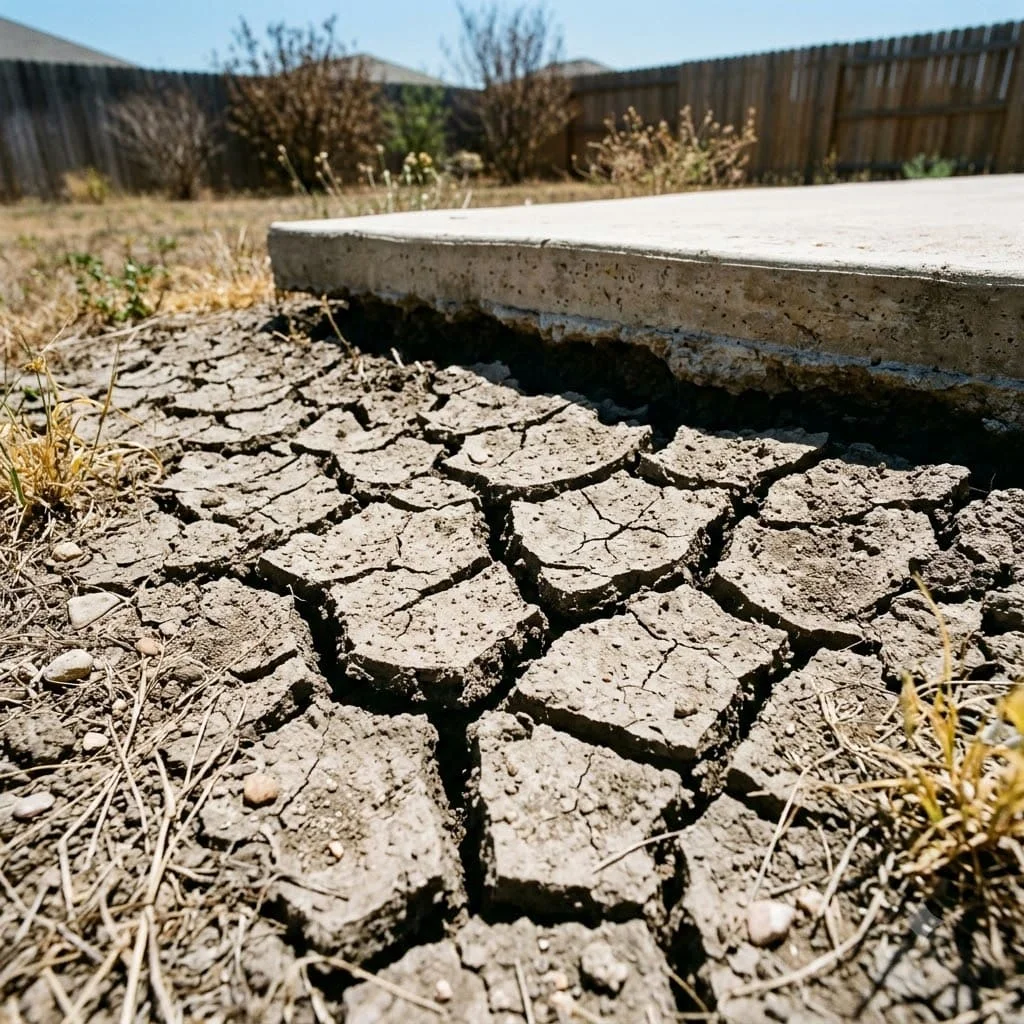
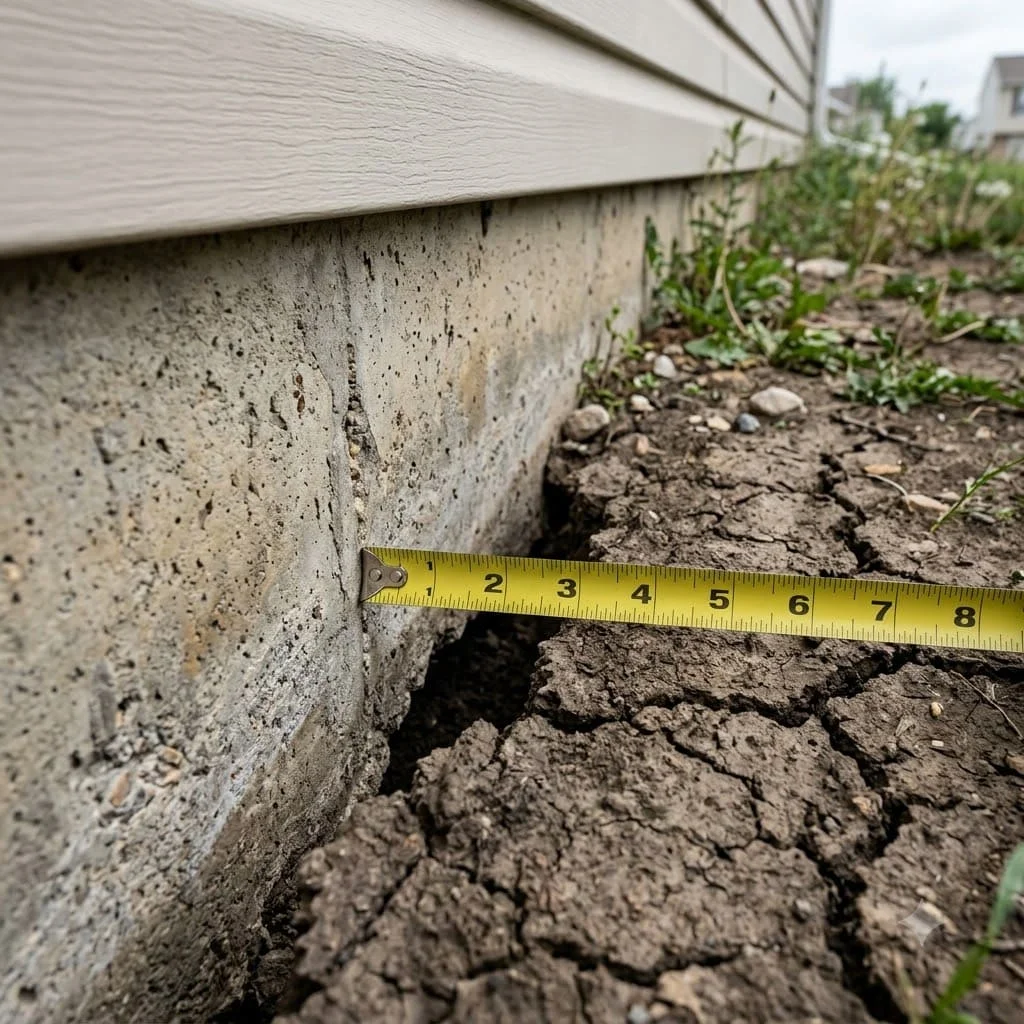
In a wet spring, clay near the surface absorbs water and pushes upward against whatever is resting on it — a slab edge, a grade beam, a pier footing. As summer heat sets in and rain slows down, the same clay gives that moisture back and shrinks, pulling away from whatever it was pushing against. That is why a gap opens up between the soil and a slab's edge by late August in a dry year, sometimes wide enough to fit a hand into.
A house built on stable ground barely registers this cycle. A house built on Blackland clay feels it every year to some degree, because the soil directly under the perimeter of a slab dries out faster than soil under the center of the house, which is shaded and insulated from evaporation by the structure above it. That difference — dry, shrinking soil at the edges and more stable, moisture-retaining soil in the middle — is what drives most of the edge lift and edge drop patterns Pflugerville homes develop.
What it looks like
The gap that opens by late summer.
A visible gap between dried soil and a slab's edge is not damage by itself — it is the clay doing exactly what expansive clay does. It becomes a problem when that shrinkage is uneven across the perimeter, pulling one section of the slab down more than the rest.
Why drought years hit hardest
The swell-shrink cycle happens every year, but it compounds during a real drought because the soil never gets the wet season back it needs to reset. Central Texas has been through three sharp ones this century: 2011, when nearly 88% of the state reached exceptional drought status at its peak; 2022, the worst drought year since 2011; and a dry stretch running into 2023, with the four years ending that June ranking among the driest four-year periods on record for the region. Each of those years produced a spike in foundation repair calls across Central Texas, because months of accumulated shrinkage showed up as cracking and settlement all at once rather than gradually.
Slab foundations vs pier-and-beam: same soil, different symptoms
A slab-on-grade foundation sits directly on the clay, so it moves with it — mostly at the perimeter, where the soil dries fastest, producing the edge cracks and door-frame racking covered in common warning signs. A post-tension slab resists this better than an older non-tensioned slab because the embedded steel cables hold the concrete in compression, but tension cables do not stop the soil from moving underneath — they just make the slab more resistant to cracking while it happens. See slab foundation repair for how that movement gets corrected once it is significant.
A pier-and-beam foundation reacts differently: the house sits on individual piers rather than a continuous slab, so a pier can settle or heave on its own without the same rigid connection pulling the rest of the structure with it. That tends to show up as localized soft spots or sloping in one room rather than a single dramatic crack, and it is often more straightforward to correct because individual piers can be shimmed or replaced — see pier and beam foundation repair for how that process works.
What actually reduces the movement
The soil itself cannot be changed, but how much water reaches it can. Keeping moisture levels around the foundation consistent — rather than soaked in spring and bone-dry by August — is the single biggest factor a homeowner controls. A soaker hose run along the foundation perimeter during extended dry stretches, kept far enough back to avoid pooling against the slab, helps prevent the soil from shrinking as dramatically as it otherwise would. Grading that carries rainwater away from the foundation instead of letting it pool matters just as much, and so does keeping large trees at a reasonable distance — live oaks and cedar elms in particular pull enormous volumes of water from the soil during the growing season, and a mature tree close to a foundation can dry the clay beneath one side of a house faster than the rest.
None of that stops the clay from moving entirely — it reduces how unevenly it moves, which is what actually damages a house. Homeowners in Round Rock, Hutto, Manor, and north Austin are dealing with the same clay and the same tradeoffs. If cracking or an uneven floor has already shown up, a foundation inspection with a floor elevation survey is the only way to tell how much the soil has actually moved and what, if anything, needs correcting.
Wondering what your soil is doing to your slab?
Get a free, no-obligation foundation inspection for your Pflugerville home, including a floor elevation survey.