Home / Foundation Crack Repair
Slab, wall & masonry cracks
Foundation Crack Repair in Pflugerville, TX
Some cracks are concrete doing what concrete does. Others are the first visible sign that one side of your house is going down. Knowing the difference is most of the job.
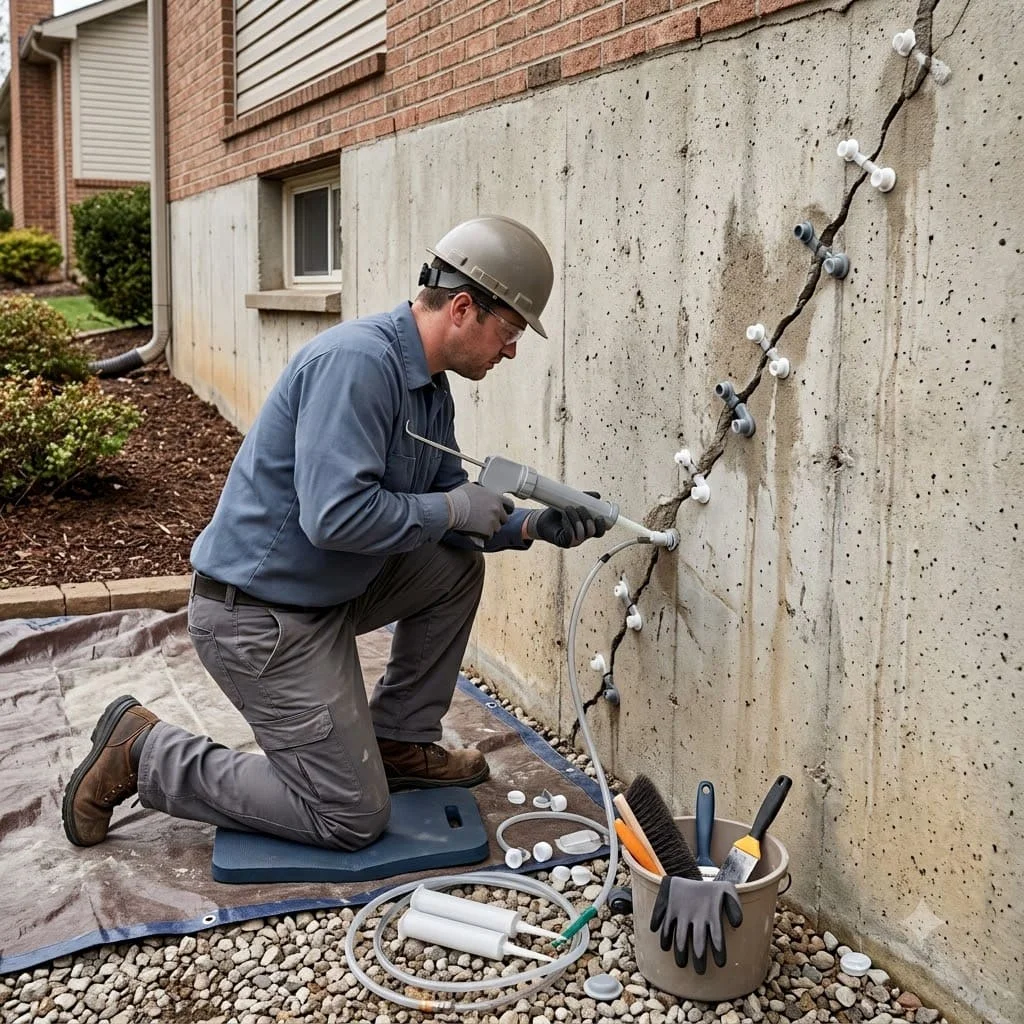
Overview
Not every crack means trouble
Concrete cracks. It shrinks as it cures, it moves with temperature, and it flexes under load — a house with zero cracks anywhere is the rare one. The useful question is never whether you have a crack. It is whether the crack is telling you the ground underneath has moved.
In Pflugerville the answer often is yes, because the Blackland clay under most of this town swells and shrinks dramatically between wet and dry seasons. But plenty of the cracks homeowners call about here turn out to be shrinkage or framing movement, and paying for structural work you do not need is its own kind of bad outcome.
Direction, width, and change over time are the three things that matter. A narrow vertical crack that has looked the same for a decade is not the same animal as a diagonal crack over the back door that grew through last summer.
Reading the crack
Use this to get a rough sense of what you are dealing with before anyone comes out. It is not a substitute for measuring, but it will tell you whether to be relaxed or attentive.
| Crack type | What it looks like | What it usually means | Typical fix |
|---|---|---|---|
| Hairline / crazing | Fine surface lines, under ⅛ inch, often in a web pattern | Normal curing shrinkage | Cosmetic patch, or nothing at all |
| Vertical | Straight up-and-down, even width top to bottom | Shrinkage or minor uniform settlement | Polyurethane or epoxy injection if it seeps |
| Diagonal | Roughly 45°, often from a door or window corner | Differential settlement — one area dropping | Stabilize with piers, then repair the crack |
| Stair-step | Follows brick or block mortar joints in a staircase pattern | Foundation edge settling under that wall | Piers, then tuckpointing the masonry |
| Horizontal | Runs level along a wall, sometimes with bowing | Lateral soil pressure — the most serious type | Carbon fiber or wall reinforcement, evaluate promptly |
| Offset / displaced | One side of the crack sits higher than the other | Active vertical movement | Elevation survey first, then underpinning |
A simple test: mark each end of the crack with a pencil and date it. If the marks are still at the ends six months later, the crack is stable.
Repair methods
Fixing the crack, or fixing what caused it.
Injection repairs the concrete. Piers repair the reason the concrete broke. A good contractor tells you which one you are buying — and does not sell you the second when you only need the first.
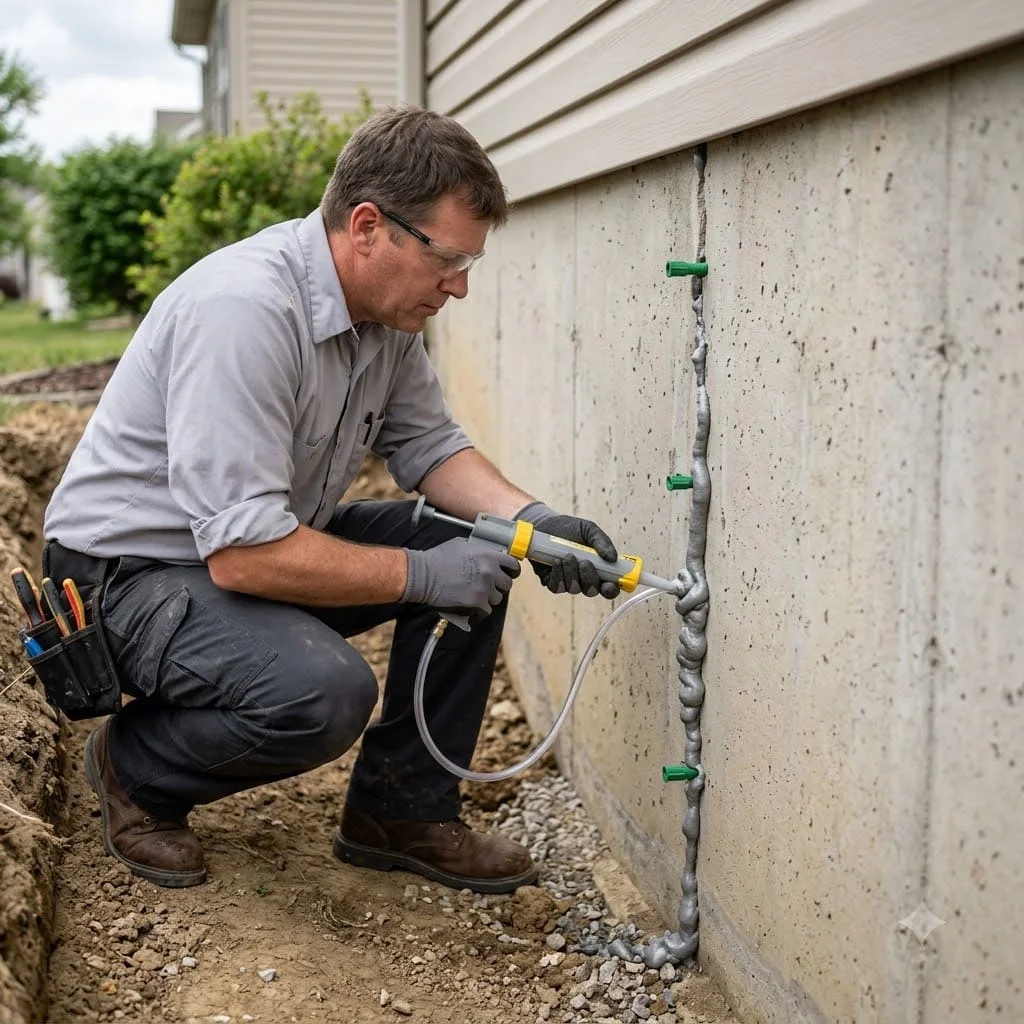
Epoxy injection
A structural adhesive injected under pressure that bonds the concrete back together, often stronger than the original. Used on non-moving structural cracks where the goal is to restore the slab or wall as a single unit.
Polyurethane injection
A flexible resin that expands to seal the crack against water. It does not restore strength, so it is the right tool for stopping seepage through a crack that is not a structural concern.
Carbon fiber reinforcement
High-strength straps epoxied across a crack to stop it from widening further. Common on cracked stem walls and masonry, and far less invasive than rebuilding the section.
Piers, when the ground is the problem
If the crack is a symptom of one part of the house dropping, filling it is cosmetic. Stabilizing the foundation with piers comes first, and the crack repair is the finishing step afterward.
When to make the call
Cracks that deserve a measurement, not a patch
- Any horizontal crack in a foundation wall, especially with bowing.
- A crack wide enough to slide a nickel into, or one that has visibly grown in a year.
- Stair-step cracking in brick near a corner or above the garage opening.
- Matching cracks inside and outside on the same wall.
- Cracks paired with sticking doors, sloping floors, or separated trim.
- Water seeping through a crack after heavy rain.
The evaluation is free, and it settles the question with elevation readings rather than opinions. We repair cracks throughout Pflugerville and also serve Round Rock, Hutto, Manor, and Austin. If the readings come back clean, we will say so — plenty of the calls we take end with a homeowner relieved rather than quoted.
Our process
How we approach a cracked foundation.
Read the crack
Width, direction, whether it goes through the full thickness, whether both sides are still flush, and whether the same line shows up inside and outside all tell us something different.
Check for movement
An elevation survey answers the question that matters most: is this crack a shrinkage detail, or is it the visible edge of a foundation that is still moving?
Match the method to the cause
Structural cracks get epoxy or carbon fiber. Water-only cracks get polyurethane. Cracks driven by settlement get piers first, then repair. We will explain which is which and why.
Seal, reinforce, verify
Ports are set, material is injected until the crack is filled through its full depth, reinforcement is bonded where needed, and the surface is cleaned and finished.
Crack questions
Frequently Asked Questions
Which foundation cracks are actually dangerous?
Horizontal cracks are the ones to take seriously — they suggest lateral soil pressure pushing on a wall, and they do not get better on their own. Stair-step cracks in brick or block wider than about a quarter inch usually mean real differential settlement. Wide diagonal cracks running from door and window corners are the same story. Narrow vertical cracks and fine surface crazing are almost always shrinkage and are far less concerning.
Are hairline cracks in a slab normal?
Yes. Concrete shrinks as it cures, and thin cracks under about an eighth of an inch that have not changed in years are extremely common in Pflugerville homes and typically harmless. What matters is change. A crack that has widened noticeably in a year, that you can slide a nickel into, or that has one side sitting higher than the other is a different situation and deserves a measurement.
Can I just fill the crack myself?
You can seal a minor cosmetic crack with a concrete patch or caulk, and for hairline cracks that is a reasonable weekend job. What a homeowner patch cannot do is restore structural strength or stop movement, so if the crack is opening because the slab is settling, the filler will simply crack again along the same line. Fill it only after you know the foundation is stable.
How much does foundation crack repair cost?
In this area, injection repair generally runs about $400 to $1,200 per crack depending on length, depth, and access, and carbon fiber straps run roughly $400 to $800 each. Those numbers only apply when the crack is the whole problem. If the cracking is caused by settlement, the real cost is the underpinning, and our foundation repair cost page covers those ranges in detail.
Why do cracks keep coming back after I patch them?
Because the patch treats the symptom. If the soil under one part of your foundation is still shrinking and swelling with the seasons, the structure keeps flexing and the repair reopens along the weakest line — usually the same one. This is very common on Blackland clay. Stabilize the movement first, then patch, and the repair holds.
Find out what that crack is really doing.
Free crack evaluation and elevation survey for Pflugerville homeowners — with an honest answer either way.