Home / Concrete Leveling
Mudjacking & foam lifting
Concrete Leveling in Pflugerville, TX
A sunken driveway panel or a patio that has pulled away from the house does not need to be torn out. Lifting it back into place usually takes a few hours and costs a fraction of replacement.
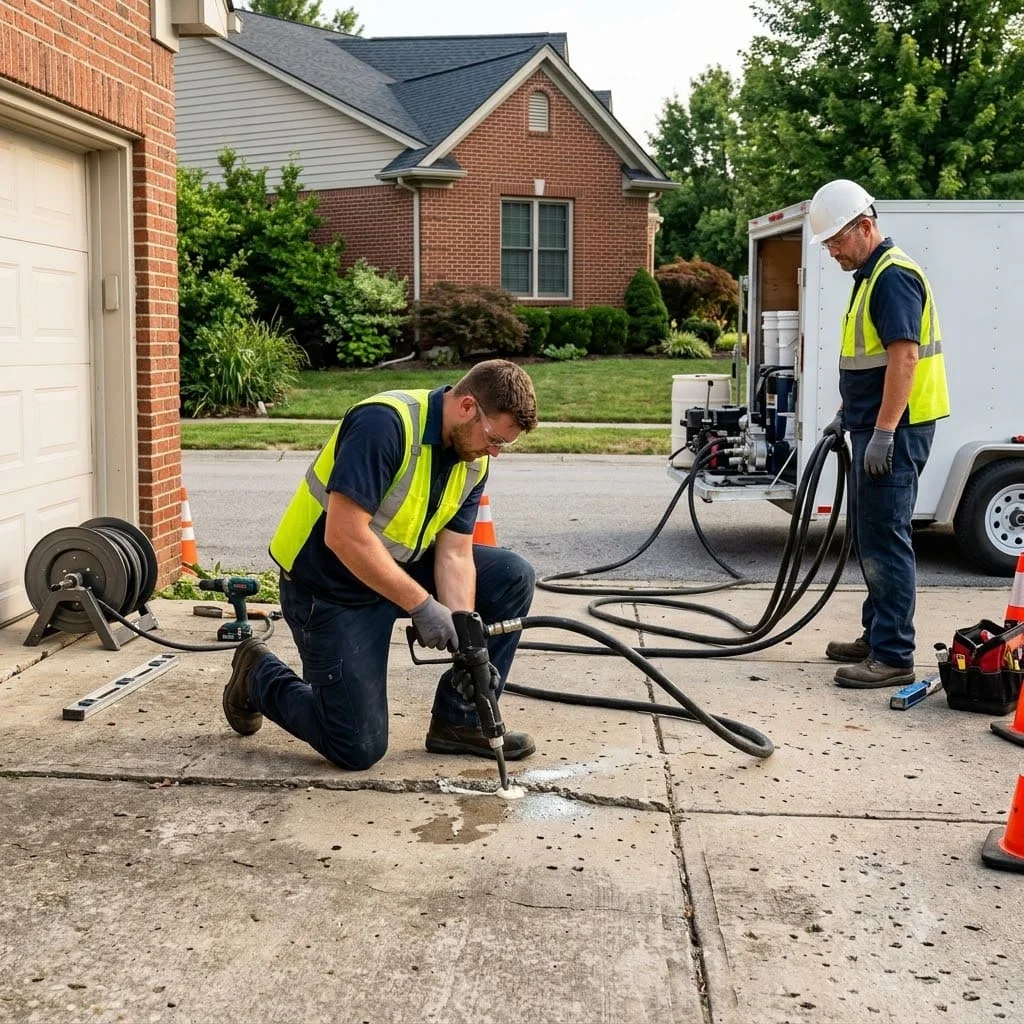
Overview
What makes concrete sink around here
Concrete does not settle on its own — the ground under it moves, and the slab follows. Across Pflugerville, the same expansive Blackland clay that troubles house foundations shrinks away from flatwork during dry stretches, leaving a driveway or patio spanning a void until it cracks and drops.
Water does the rest. A downspout discharging at the edge of a driveway, a curb line that collects runoff, or an irrigation head leaking under a sidewalk will quietly wash soil out from underneath the slab. Fill that was placed during construction and never compacted properly — very common at driveway approaches and garage aprons — keeps consolidating for years after the house is finished.
Sunken flatwork next to the house is worth fixing quickly. A patio that has tipped back toward the foundation dumps rainwater against your slab, which is exactly the condition that leads to the more expensive foundation repair conversation a few years later.
Two ways to lift a slab
Both methods work by filling the void beneath the concrete and using controlled pressure to raise the panel. What differs is the material going in, and that difference matters more than most people expect.
Mudjacking pumps a slurry of sand, cement, and soil through holes roughly an inch and a half across. It is proven, inexpensive per square foot, and well suited to thick slabs and large commercial areas. Its downside is weight — slurry is heavy, and adding weight to soil that was already too soft to hold the slab is not always the right move.
Polyurethane foam lifting injects a two-part expanding structural foam through ports about the size of a penny. It cures in roughly fifteen minutes, weighs a small fraction of slurry, does not absorb water, and gets the driveway back in service the same day. For residential work in this area it is usually the better choice, and it is what we recommend most often.
Residential and commercial work
On the residential side, most calls are driveways, front walks, patios, porch slabs, pool decks, and garage floors. On the commercial side it tends to be warehouse floors, parking areas, loading approaches, and uneven sidewalk panels that have become a liability at storefronts and offices. The equipment is the same; the scale and the scheduling are not.
We handle both throughout Pflugerville and the surrounding communities, including Round Rock, Hutto, Manor, and Austin.
Mudjacking vs foam
Which method belongs on your slab.
Neither method is universally better. The right answer depends on slab thickness, how soft the soil is, how quickly you need the surface back, and what the panel is being used for.
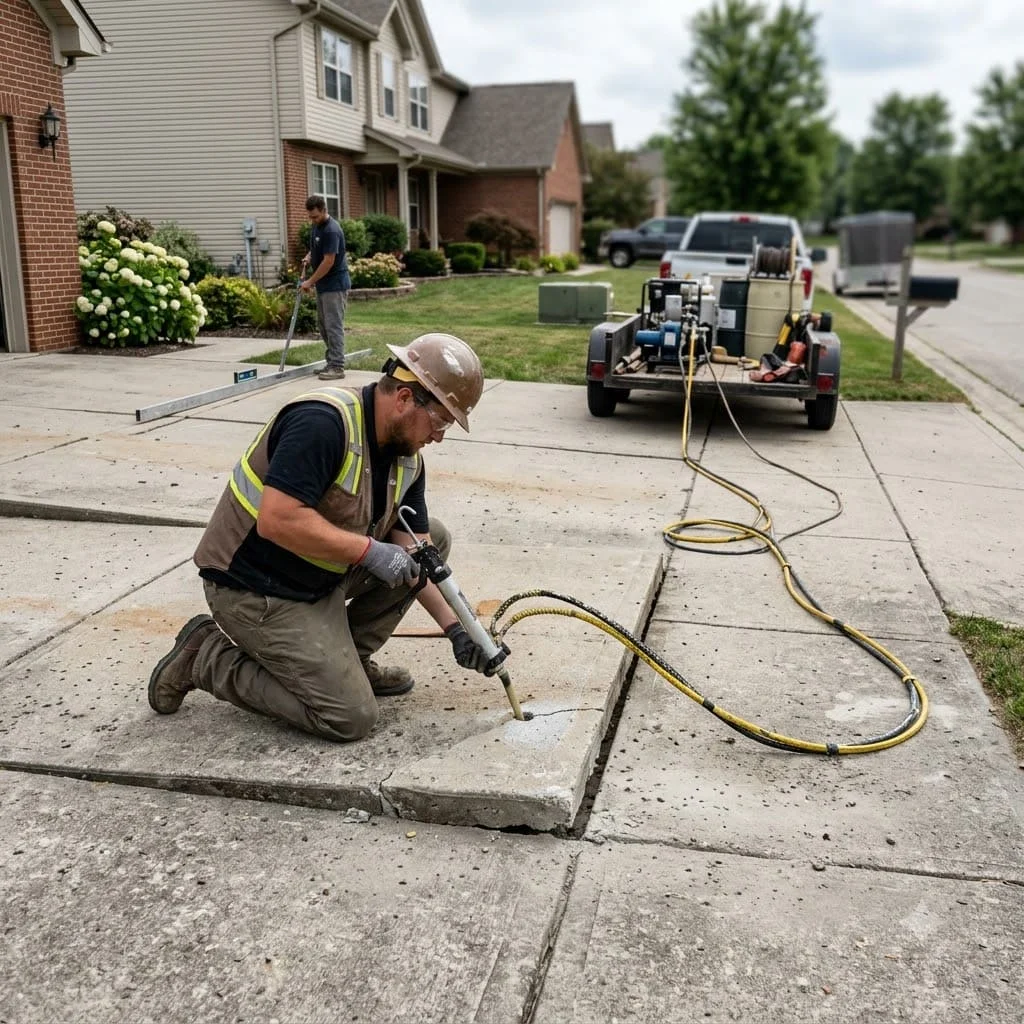
| Mudjacking | Polyurethane foam | |
|---|---|---|
| Injection holes | About 1½ inches | About ⅝ inch |
| Weight added | Heavy — roughly 100 lbs per cubic foot | Light — roughly 4 lbs per cubic foot |
| Cure time | Several hours to a day | About 15 minutes |
| Water resistance | Can erode over time | Does not absorb water |
| Typical cost | $3 – $8 per sq ft | $8 – $18 per sq ft |
| Best for | Thick slabs, large commercial areas, tight budgets | Driveways, patios, garage floors, soft or wet soil |
Replacement, for comparison, typically starts around $12 to $18 per square foot once demolition and hauling are included.
What we lift
The slabs that sink first.
Driveways and approaches
The section where the driveway meets the street or the garage apron is almost always the first to drop, because that is where fill was placed during construction and never fully compacted.
Patios and pool decks
Slabs poured against the house that settle away from it create a gap at the door threshold and send rainwater back toward the foundation — a small problem that causes a bigger one.
Sidewalks and walkways
Uneven joints that stick up more than half an inch are a genuine trip hazard. Lifting the low panel is a fraction of the cost of tearing it out and repouring.
Garage floors and porches
Voids under a garage slab show up as a hollow sound and a floor that has dropped away from the wall. Lightweight foam is ideal here because it fills the void without adding weight.
Our process
How a lift is done.
Find out why it sank
Erosion, poor compaction, clay shrinkage, and leaking irrigation lines all look the same from above. Lifting concrete over an unfixed washout just buys you a couple of years.
Drill small ports
Penny-sized holes for foam, or slightly larger ones for mudjacking slurry, are drilled through the slab in a pattern that spreads the lift evenly across the panel.
Inject and lift
Material is pumped in under controlled pressure while we watch the slab with a level. It rises in small increments until the panel meets its neighbors and the void underneath is full.
Patch and clean up
Ports are filled with color-matched grout, the area is swept, and the surface is ready to walk on immediately. Foam-lifted driveways can take vehicle traffic within the hour.
Concrete questions
Frequently Asked Questions
Why is my driveway sinking in Pflugerville?
Usually one of three reasons. First, the fill placed under driveway approaches during construction was never fully compacted and continues to consolidate for years. Second, the Blackland clay underneath shrinks during dry stretches and leaves the slab spanning a void. Third, water from a downspout, a curb, or a leaking irrigation line erodes soil out from under the edge. We look for all three before quoting the lift.
Which is better, mudjacking or polyurethane foam?
Foam is better for most residential work here. It weighs a fraction of what slurry does, so it does not overload the same soft clay that caused the problem, it cures in about fifteen minutes, and the injection holes are much smaller. Mudjacking still makes sense on thick industrial slabs and large flat areas where material cost matters more than weight, and it typically costs less per square foot.
How much does concrete leveling cost?
In the Pflugerville area, mudjacking generally runs about $3 to $8 per square foot and polyurethane foam lifting about $8 to $18 per square foot, with most residential jobs landing between $700 and $2,500. That is still far below replacement, which typically starts around $12 to $18 per square foot once demolition, hauling, forming, and new concrete are included.
How long does the concrete last after it is lifted?
The lift itself is permanent as long as the reason it sank has been addressed. Foam does not wash out or break down, and mudjack slurry cures hard. What can still fail is the soil, so if a downspout is still dumping at the corner or an irrigation line is still leaking, the slab will eventually drop again. Fixing the water is what makes the repair last.
When should I replace the concrete instead of lifting it?
When the slab itself is failing rather than just settling. Concrete that is broken into several pieces, badly spalled across the surface, or cracked into sections smaller than about three feet cannot be lifted as a unit and should be replaced. If the panel is largely intact and simply sitting too low, lifting is faster, cheaper, and keeps the existing finish and color.
Lift it instead of replacing it.
Free on-site quotes for driveways, patios, sidewalks, and garage floors across Pflugerville and the surrounding area.